This morning, while waiting for an email to show up, I did my usual surfing the net for new writers who are deaf and hard of hearing.
I stumbled upon Stephen Hopson's Squidoo Lens: Adversity University. This lead me to his blog which stated: I'm a former award-winning Wall Street stockbroker turned motivational speaker, writer and pilot. In Feb 2006, I became the first deaf pilot in in the world to earn an instrument rating.
I especially enjoyed his article, "Remember Who Helped You Along The Way." There are two itinerant teachers who stand out in my memory: Mrs. Rellis and Mrs. Sweeney. Mrs. Rellis worked with me during my first two years in high school. At first, I did not enjoy our sessions. I didn't like being pulled out of class for "extra help." Mrs. Rellis didn't give up. She quickly learned to make our sessions fun and informative. She taught me a few words in Italian as she related her plans for a trip to Italy. She found ways to talk to me about my feelings and gently made me face the issues I had with being hard of hearing. She connected me to Shawn, another student who also had hearing aids and she became my first friend that I could truly relate to about hearing loss.
I was heartbroken when Mrs. Rellis told me that I was getting a new teacher two years later, but I learned to enjoy Mrs. Sweeney as well. Mrs. Sweeney discovered my love for writing and she encouraged me to write in different ways. During our final session at the end of high school, she took me out to lunch and presented me with a blank journal. That journal is one of my treasured possessions today.
So, as Stephen Hopson suggested, remember who helped you along the way. Do you have a story to share about a special someone?
Thursday, December 28, 2006


Tuesday, December 26, 2006
Happy Holidays!
Happy Holidays to everyone!
We just returned from Michigan and Oak Forest, spending time with both sides of the family. I'm looking forward to having the kids at home for the next two weeks. The house is filled with the usual after-Christmas chaos, half of the stuff here and the other half there and one happy chew-anything dog who is getting into everything. The kids are already clamoring for batteries, screwdrivers and scissors and it's only eight a.m.
I'm crawling back into bed instead.
Thursday, December 21, 2006
Working as a Deaf Mentor
When people ask me, "What do you do," I usually reply that I work in early intervention. I work as a Deaf Mentor. The definition, from the Hearing and Vision Connections website is: Deaf Mentors are enrolled under Family Support, but are not credentialed. They are available to go into the home, ideally working in close coordination with a DT(Developmental Therapist)/Hearing provider, to share personal experiences, teach sign language or the family's chosen method of communication, and introduce information about having a hearing loss, the Deaf community and Deaf culture.
I have been doing this for three years, serving about 25 families from birth to age three. I am seeing a major trend: the majority of families with babies with profound hearing loss are choosing implants. In Chicago recently, a seven-month old baby received two cochlear implants . Some of the kids with implants take right off with listening and spoken language. For others, it's a slower process and the results are not as immediate. For some families, the implant does not work for their child.
I really do enjoy working with the variety of families on a weekly or monthly basis but I'm sometimes the resource of last resort. Sometimes I will receive referrals to families when the children are almost three. Some of the families are quite a distance from my home, so I'm often on the road for long periods of time. I'm self-employed, which means that I handle my own billing and take a tax write off on the number of miles I commute.
The most rewarding aspect of the job is seeing the communication and language development that happens with each child and family. I love it when a mom or dad tells me, "My child said/signed 'I love you!'"
Sunday, December 17, 2006
Reflections of a Basketball Game
Steven, my youngest kiddo, had a basketball game on Saturday and we headed over to the gym a few minutes before game time. The night before, he came up to me and said, "I don't want to go to the game, Mom."
So we sat down to talk about it.
Turns out, he becomes extremely nervous before the games. He's an excellent athlete, but the jumbling of nerves gets in the way of his playing skill. "I don't want to play basketball anymore," he declared.
My heart sank. I knew that he really loved to play because he was a totally different kid at the local YMCA, when playing for fun with his family. What was really going on? Could it be, I suspected, the difficulty with understanding what was being said during the game?
Steven has a moderate-to-severe hearing loss. He is able to use his voice well, which leads others to think that he can understand conversation at every level in every situation.
Not so.
Let me share my experience. I teach a class in Conversational Sign Language at the local community college. A few weeks ago, we combined classes with another instructor and showed a video by Peter Cook. During the discussion afterwards, a question about varying types of hearing loss came up. I explained that I was completely deaf without my hearing aids but that my hearing aids gave me access to environmental sounds. I rely almost 100% on lipreading in conversations.
"But how can that be," asked one student. "You speak so well."
So I asked the student to say something to me while I turned around. "Eye Are a oyee ahin ee ah."
Turns out she said, "Hi Karen, thank you for teaching class."
The student had a speechless look on her face. Suddenly, she understood what things sounded like to me and how much information had to be delivered visually for communication.
I hear mostly vowels. Lipreading/speechreading gives me visual clues which I piece together with the sounds coming in and fill in the blanks by understanding the context of what is being said. You can read more about it here: Yo, I'm Deaf!
While Steven hears much better than I ever did while growing up, I suspected that he was losing his ability to discriminate words. I was right; a recent hearing test showed that his ability to understand words by hearing alone dropped to about 38 percent.
It was too late to grab an interpreter for Saturday's game so I talked with the coach. I explained about the drop in Steven's ability to comprehend speech. The coach shared that he was totally deaf in one ear, something that he didn't tell us before. So he took Steven aside and told him and Steven's face lit up. He suddenly had a connection with the coach that he didn't have before and it seemed to put him at ease a bit.
Yet, the jumble of nerves was still there as Steven started the game. I had to sit back and remind myself that he was kid, that perhaps this would be the same thing we'd face even if he had normal hearing. Sometimes it's hard to figure out the difference.
But anyway, let me brag. Steven's team won the game and he made one beautiful, swish shot from near the three-point line.
That's my boy.
Wednesday, December 13, 2006
Karen Meyer-- A Chicago Reporter Who is Deaf

Tune into WLS Channel 7 in the Chicago area on Thursdays and Sundays and you'll find Karen Meyer reporting on people with disabilities.
Karen is deaf and has been doing the news since 1991, producing 104 stories per year. The current news segments can be viewed weekly, with the links to older stories found here: Karen Meyer News Segments.
For more information about Karen: Achieving Dreams Through Persistance.
Monday, December 11, 2006
The BookHands Holiday Pick

On Saturday night, ten of us from the BookHands book club gathered at my house for our annual holiday party.
The book for the night was Marley & Me: Life and Love with the World's Worst Dog
 a beautifully-written story about a loveable yellow lab named Marley. Everyone gave it a thumbs up, including the gals who never had a dog as a pet.
During the discussion, we shared stories of our own pets. One of the gals, Patti, brought in pictures of her dogs. Years ago, she owned a lab named Penny, who was so like Marley that she felt she could have written the same book. She was newly married and her husband wasn't particularly fond of Penny. One day, Penny tugged at some newspaper on the floor and tipped over a can of white paint that was loosely covered. Paint seeped into the wooden floor. Patti cleaned up the paint the best she could, but they ended up refinishing the floor. Her husband wasn't too pleased, but over the years, he learned to accept Penny as part of the family.
If there's one book that you buy for the holidays-- pick up Marley and Me. I enjoyed this book so much that I had to share an Epinion: Marley and Me, Your Heart Will Be Captured.
On another note, this weekend was a weekend of splurging on chocolate and cookies in a major way. Lauren attended a birthday party where the girls made cookies for several hours. Here's what she brought home:

Needless to say, there isn't much left on Monday morning.
Wednesday, December 06, 2006
A Mother-Son Bonding Moment
I had a bonding moment with my 13-year-old son recently. A few weeks ago, I casually mentioned that he might like the Weird Al Yankovic videos and songs. He gave me his customary eye-roll and his "W" sign for Whatever, Mom.
I loved the Weird Al parodies of Michael Jackson's Eat It and Thriller songs when I was a few years (ahem!) younger. Back then, I had to beg a friend to write down lyrics to songs and none of the videos were captioned on MTV.
Then a few days ago, David excitedly motioned me to come into the office. "Look mom, you gotta see this. It's hilarious!" On the computer screen he pulled up Weird Al's White and Nerdy. Being the typical clueless Mom, I had never heard of Ridin' Dirty by Charmillionaire, the song that is parodied by Weird Al. David pulled up the lyrics and started the video.
They see me mowin' my front lawn
I know they're all thinkin' I'm so
White and nerdy
Think I'm just too white and nerdy
Think I'm just too white and nerdy
Can't you see I'm white and nerdy
Look at me I'm white and nerdy
I wanna roll with the gangstas
But so far they all think I'm too
White and nerdy
And there's Weird Al, dressed up quite nerdy, extending his hand out to the gangsters in a convertible, who desperately try to lock the door and peel away quickly.
Hilarious indeed!
We watched the video several times together, laughing so hard that the other kids came in and joined us. We watched Another One Rides The Bus, a parody of "Another One Bites The Dust. "Hey kids," I said, "Do you want to see a video that I used to watch when I was in high school?"
"You mean Weird Al was around back then?" they replied, incredulous.
It was my turn to roll the eyes.
So we watched "Beat It." (The kids were amazed at how normal Michael Jackson looked back then!). Then we roared with laughter at Weird Al's "Eat It."
Yes, it would have been much better if the video was captioned on the internet. I'm just so glad that my kids can instantly look up lyrics. I'm glad that they have the ability to adapt the Ipod for use with their hearing aids.
And I'm very thankful for the incredible bonding moment that Weird Al brought us.
Tuesday, December 05, 2006
A Very Rare Photo-- Wash Hung Up to Dry

Look closely. Yup, your eyes are not deceiving you. Yes, there's snow on the ground. Someone hung the wash outside on a beautiful, sunny, wintery day.
My mom and my sister are down in Ste. Genevieve, Missouri visiting some relatives. Yup, those are the people that hung up that wash. Relatives of ours.
I grew up helping my mom hang out the wash several times a week. We had a working dryer in the basement, yet my mom chose to hang up the wash on sunny days. She had a system: sheets were hung on the outside lines, our unmentionables were hidden on the inside lines. I used to grumble about having to go outside, gather up the dry clothes and help her fold them. Little did I realize that I was getting my daily dose of Vitamin D and fresh air, a combination that does a body good.
Monday, December 04, 2006
A Weekend of Fun for Deaf and Hard of Hearing Kids


What a Saturday! West Suburban Association of the Deaf and Harper College ASL Club hosted a Holiday Party for 110 kids. Mr. and Mrs. Santa Claus were there and gave out stocking stuffers from the WSAD/ASL clubs and frisbees donated by i711/GoAmerica. The kids had a blast jumping in a castle, making crafts, playing games and hitting pinatas. Hotdogs, pizza, salad and cookies were served non-stop. Judging from the smiles on the kids' faces, everyone was having a good time.
Later that night, the Seven Bridges Ice Arena hosted the Disabled Hockey Games, which included a team from the American Hearing Impaired Hockey Association. Somewhere in the blur of skaters, you will find Kurt Bernabei, a future Deaf Olympic hockey player. On another rink there was a sled hockey competition for hockey players with mobility disabilities.

Friday, December 01, 2006
I MacGyvered the Snowblower!

This morning, we woke up to several inches of snow. The kids excitedly jumped into their snowsuits at eight in the morning and began shoveling the driveway. When I arrived outside, I was amazed at how much snow covered our cul-de-sac.
The hubby tried to start the snowblower last night to no avail. I figured I would give it a try. The primer button was all cracked, but the electric starter roared to life. The machine just wouldn't start and get going. With no way to prime it, I couldn't get the gas moving through.
"What would MacGyver do?" I muttered to myself. For those of you with no clue, MacGyver was a show in the 1980's that featured Richard Dean Anderson as a special agent who used common objects to fight crime and get himself out of tight situations. Candy bars, paper clips, gum were some of the items he used, often with just seconds to spare before disaster would happen.
So I looked at the primer button and discovered that I needed to create some kind of suction or forced air to get the gas moving. The bicycle pump! I searched all over the garage but couldn't find it. My eyes settled on the leaf blower. Nah, too powerful. I looked at the primer button again. There was a hole as wide as the end of a paper clip. A straw, I thought to myself. I can blow through a straw...
On the way to the kitchen, I suddenly realized that I had the perfect tool to use on the primer: the hearing aid tube blower.

And sure enough, one squeeze of the bulb blower and the snowblower roared to life!
Monday, November 27, 2006
Are Restaurants Your Second Home?

I recently discovered Restaurant.com and it is a great site to get gift certificates for local restaurants at deep discounts. No gimmicks-- simply purchase a $25 gift certificate for $10 and head out to any of the many restaurants listed on the site. Click the link above for details on restaurants covered by this program.
Joe and I like to eat out often and this is a great way for us to sample different restaurants without paying full price.
Fortunately, Domo 77 is not one of the restaurants listed-- because I certainly won't be going back there: What Are We, Chopped Liver?
Sunday, November 26, 2006
The Deaf Doc is In!
It's that time of the year when we get hit with the usual alphabet soup of winter ills: bronchitis, colds, flu and more. Dr. Carolyn Stern has a brand new medical website, DeafDOC, filled with information on a variety of health topics. Dr. Stern is a board certified family physician who practices in Rochester, New York. The unique aspect of this website: the information is given in American Sign Language as well as voiced and captioned.
I first met Dr. Stern when she practiced at Lutheran General in the Chicago area several years ago. I was filled with a lot of questions, such as how to hear a heartbeat (she uses an amplified stethoscope) and how to measure blood pressure (it can also be measured manually through the hands). At that time, I was learning how to become a doula and had the opportunity to attend several births, including a home waterbirth. I was toying with the idea of a career in the birthing field. Dr. Stern was an inspiration, as she was catching babies and serving entire families with her practice. As it turned out, I pursued early intervention instead and got involved with Hands & Voices.
Dr. Stern has a section on her website where you can Ask the Doc and get some feedback on your health concerns. She is also available as a speaker and a consultant.
Friday, November 24, 2006
Midwest Center for Law and the Deaf Fundraising Bash
On Thursday, November 22, the annual Midwest Center for Law and the Deaf fundraiser was held at Prairie Rock restaurant in Schaumburg. The Midwest Center for Law and the Deaf, or MCLD as it is known among Chicagoans, was created by Chicago attorney Howard Rosenblum. The non-profit organization:
--Trains and recruits attorneys to serve the unique needs of deaf and hard of hearing clients
--Educates deaf and hard of hearing people on their rights
--Trains interpreters on how to deal with the unique challenges of working within a courtroom or other legal settings
--Provides resources to families and friends of deaf and hard of hearing people
--Prepares law enforcement officers to effectively communicate with deaf and hard of hearing people
--Aids courts in ensuring full access to the justice system by deaf and hard of hearing parties, attorneys, witnesses, jurors, and spectators.
 The annual fundraiser covers the cost of a part-time staff person and services offered by MCLD. Howard works tirelessly year after year to ensure that deaf and hard of hearing persons have access to legal representation. And, as Howard jokes, "so that deaf people can sue other deaf people."
So this year, if you're looking for a charitable contribution, the Midwest Center for Law and the Deaf is an organization worthy of donations.


Sunday, November 19, 2006
Mom's Night Inn-- What a Blast!
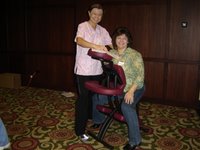
The 2006 Mom's Night Inn hosted by Illinois Hands & Voices was held on Friday, November 17th and Saturday, November 18th. Thirty four moms of deaf and hard of hearing kids gathered together for a night of connecting, sharing and laughing.

We started off with introductions and then jumped right into an interactive presentation, "Taking a Trip Down Guilty Lane, How to Arrive in Paradise Instead." Motherhood and guilt, they go hand-in-hand. To ease any guilt that remained, we finished off the evening with massages, manicures, crafts and food.
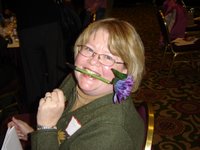 After Saturday morning's breakfast, we sat back to listen to a group of panelist share their life's experiences. Ben Lachman, Erika Lohmiller, Tony Abou Ezzi and Carol Nemecek answered question after question from the moms and gave some great advice. The panelists had a varied background: Cued Speech, American Sign Language, spoken language and simultaneous communication.

 The feedback from the moms echoed the same sentiment over and over: "It was so wonderful to connect with other moms of deaf and hard of hearing children."
And of course, everyone enjoyed the huge wicker basket filled with chocolate that we served non-stop throughout the event.

Check out the experience of Juliet Martinez, one of the moms who attended: I Just Needed a Slumber Party!
Thursday, November 16, 2006
The Lions Club
This week, I was invited to attend a Batavia Lions Club meeting and introduce Illinois Hands & Voices to their members. The Lions provided a delicious dinner and an interpreter.
There were thirteen Lions in attendance, with the majority of them over the age of sixty. The Lions president, Todd McPencow, however was a young guy who fit right in and seemed very comfortable with his ability to lead. As I sat there watching the proceedings, I was struck by a sense of honor and commitment from the men in the room. The Lions Clubs are known for their fundraisers and support for people with vision and hearing loss. It is considered an high honor to be invited to join as a member of the Lions.
Each local Lions Club sends funds to the Lions of Illinois Foundation which runs the Camp Lions in three locations in Illinois. This year, Camp Lions of Illinois will be celebrating their 50th year of camp. With 700 Lions Clubs around Illinois, the fundraising covers the cost of camp for every camper; each camper is required to bring just $15 to spend at the camp store and cover the cost of a camp group picture.
I worked as a camp counselor back in my college days and I have fond memories of camp. My kids have attended Camp Lions for two years in a row, and it continues to be one of the activities that they talk about the most throughout the year. At Camp Lions, it doesn't matter whether you sign, speak or cue-- the most important thing is fun.
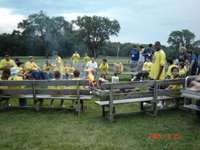
The Lions have always been a generous group, including the Bolingbrook Lions Club which provided hearing aids for my family one year and a laptop for our local deaf club, West Suburban Association of the Deaf.
After I shared information about Illinois Hands & Voices and Hands & Voices National, the Batavia Lions concluded the meeting with a very generous donation.
To all of the Lions who work tirelessly to help the communities they serve, thank you.
There were thirteen Lions in attendance, with the majority of them over the age of sixty. The Lions president, Todd McPencow, however was a young guy who fit right in and seemed very comfortable with his ability to lead. As I sat there watching the proceedings, I was struck by a sense of honor and commitment from the men in the room. The Lions Clubs are known for their fundraisers and support for people with vision and hearing loss. It is considered an high honor to be invited to join as a member of the Lions.
Each local Lions Club sends funds to the Lions of Illinois Foundation which runs the Camp Lions in three locations in Illinois. This year, Camp Lions of Illinois will be celebrating their 50th year of camp. With 700 Lions Clubs around Illinois, the fundraising covers the cost of camp for every camper; each camper is required to bring just $15 to spend at the camp store and cover the cost of a camp group picture.
I worked as a camp counselor back in my college days and I have fond memories of camp. My kids have attended Camp Lions for two years in a row, and it continues to be one of the activities that they talk about the most throughout the year. At Camp Lions, it doesn't matter whether you sign, speak or cue-- the most important thing is fun.

The Lions have always been a generous group, including the Bolingbrook Lions Club which provided hearing aids for my family one year and a laptop for our local deaf club, West Suburban Association of the Deaf.
After I shared information about Illinois Hands & Voices and Hands & Voices National, the Batavia Lions concluded the meeting with a very generous donation.
To all of the Lions who work tirelessly to help the communities they serve, thank you.
Saturday, November 11, 2006
Chicago Hearing Society Celebrates 90 Years
Chicago Hearing Society hosted a 90th Anniversary celebration on November 9, 2006. Chicago Hearing Society has a special place in my heart because I did my graduate internship in the Social Services and Counseling department almost twenty years ago. It was there that I met Ed Hudson and we had lunch together nearly every day. Ed died in a plane crash several years ago, but when I look back at my time at CHS-- I always remember Ed.
I. King Jordan was scheduled as the keynote speaker, but due to the events at Gallaudet, he was not able to attend. Instead, Bill Graham, one of the founders of the Association for Late-Deafened Adults filled in. I first met Bill back in the early 90's, when I attended one of the first ALDA conventions in Chicago. I've always enjoyed his wry humor and his wonderful way with words.
Chicago Hearing Society put together a slide show covering 90 years of its history. The early pictures showed a group of deaf, hard of hearing and hearing persons gathered in a room. The vision back then was simple: to provide a social connection and a goal of working together to improve the lives of deaf and hard of hearing persons. That goal is still alive today, with CHS providing a variety of services to every segment of the deaf and hard of hearing population.
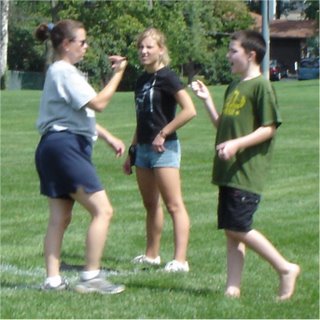 One person who simply doesn't get enough KUDOs is June Prusak. June is the Youth Coordinator at CHS and she has tirelessly planned events for deaf and hard of hearing kids all over Chicagoland. Someday, the kids she serves will be pushing her wheelchair and June will still be leading them with a smile.
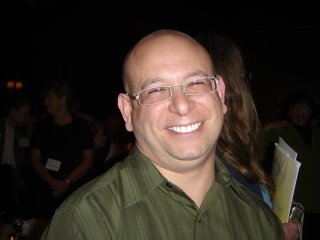 Howard Rosenblum-- Chicago's famous deaf attorney
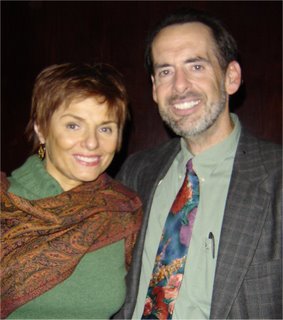 Karen and Bill Graham

CHS Volunteers
I. King Jordan was scheduled as the keynote speaker, but due to the events at Gallaudet, he was not able to attend. Instead, Bill Graham, one of the founders of the Association for Late-Deafened Adults filled in. I first met Bill back in the early 90's, when I attended one of the first ALDA conventions in Chicago. I've always enjoyed his wry humor and his wonderful way with words.
Chicago Hearing Society put together a slide show covering 90 years of its history. The early pictures showed a group of deaf, hard of hearing and hearing persons gathered in a room. The vision back then was simple: to provide a social connection and a goal of working together to improve the lives of deaf and hard of hearing persons. That goal is still alive today, with CHS providing a variety of services to every segment of the deaf and hard of hearing population.
 One person who simply doesn't get enough KUDOs is June Prusak. June is the Youth Coordinator at CHS and she has tirelessly planned events for deaf and hard of hearing kids all over Chicagoland. Someday, the kids she serves will be pushing her wheelchair and June will still be leading them with a smile.
 Howard Rosenblum-- Chicago's famous deaf attorney
 Karen and Bill Graham

CHS Volunteers
Friday, November 10, 2006
Lowell Myers-- A Lawyer Who Inspired Another
Lowell Myers, a deaf attorney who practiced in the Chicago area for years, has passed away. Myers was known for handling a case for Donald Lang, a deaf man with minimal language skills who was accused of murder. The case was later chronicled in the 1979 made-for-TV movie titled, "Dummy."
His obituary can be accessed here: Lowell J. Myers.
Chicago is home to another deaf attorney, Howard Rosenblum, who credits Myers as his inspiration to become a lawyer as well.
"Lowell Myers was a pioneer," says Howard. "He became an accountant AND a lawyer at a time when many deaf people were unable to overcome barriers to education. Mr. Myers just did not see barriers, only opportunities. Even when the Dean of John Marshall Law School told him that he could not be a lawyer because of his deafness, he did not see a barrier. Mr. Myers simply convinced the Dean to give him a chance. Not only did he graduate from law school, but he did so well that he was among the top students in the school. He did this without interpreters or any other kind of accommodation. He worked as a lawyer for many years without the benefit of the ADA or other disability rights laws. Mr. Myers just did not let such barriers stop him.
Mr. Myers also helped others see opportunities. When he came to speak about his experiences as a lawyer at an event in 1978, a twelve-year-old deaf boy saw the same opportunity that Mr. Myers saw for himself. That boy was me, and thanks to Mr. Myers, I became a lawyer 14 years later. Lowell Myers, wherever you are now, thank you for being an inspiration."
Howard works for Equip for Equality in Chicago and runs the Midwest Center for Law and the Deaf.
Tuesday, November 07, 2006
When the Kids Grab the Camera...

I was going through the photo files this morning in an effort to weed out some bad photos and back everything up with a new external hard drive we recently purchased. After wading through a couple of thousand photographs, I discovered that the kids had grabbed the camera and played around with it.
It's a little late for Halloween, but they came up with some good ones:


Friday, November 03, 2006
Ten Hearing Aids-- Never a Dull Moment
Psssst.
Come here.
Want a hot stock tip?
Invest in a battery company.

In my household, we have to keep track of ten hearing aids. The hubby and I have four, and the three kids have six hearing aids. We have an entire kitchen drawer that is devoted to packs of batteries and extra tubes. The drawers are littered with the little orange tabs that are stuck to each battery. Try as I might, I haven't been able to successfully train my kids to walk over to the garbage can (which is right across from the very kitchen drawer I spoke of) and dispose of the sticky orange tab. Instead, the drawer organizer and the cardboard packages are decorated in a random orange pattern.
One day, I took the hubby's car and on my way to a presentation, a battery went out. I changed the battery and stuck the little orange tab on the front of the steering wheel, intending to toss it when I arrived home. I promptly forgot about it until the next time I got in the car a few days later. The bright orange tab was still stuck to the middle of the steering wheel. Apparently the entire family suffers from "Orange Tab Disorder."
Despite their inability to locate garbage cans, the kids have managed to keep track of their hearing aids pretty well. Occasionally, we do have to play "Hunt for the Hearing Aid" around our house. My husband is especially good at initiating this game, for he frequently takes off one hearing aid and forgets just where he put it. This wouldn't be a problem if I kept an immaculate house, but I tend to favor piles of books and papers in random places, so we're often sifting through things around the house to try and locate a hearing aid.
With the addition of our puppy in January, we've had to be more vigilant about keeping hearing aids out of Kaycie's reach. This past summer, I was giving David a haircut outside and he placed his hearing aids on the patio steps. He went inside to take a shower and came out looking for his hearing aids. I had let Kaycie outside, not knowing that his hearing aids were out there. You guessed it-- we found Kaycie outside munching on an earmold. The hearing aids were nowhere to be seen. We located both earmolds, torn to shreds. After hauling everyone outside to join in the hunting game, we located both hearing aids. Despite a nice bite mark on one of them, they both were in working condition. This is the same kid who jumped into the lake with one hearing aid on during the previous summer. The hubby also had a lake adventure with his hearing aid: he had placed his hearing aid on a towel in the boat and accidently flung it overboard. I was able to locate the hearing aid with a scuba mask a few hours later. Today's hearing aids seem to have nine lives, as we were able to bring them all back with a Dry-Aid kit.
With ten hearing aids to keep track of, it's a miracle that we've only lost one of them. My daughter Lauren was at the library one day (this was when she was 9) and her battery went out. She didn't have a back-up battery with her, so she took off her hearing aid and put it in her sweatshirt pocket. While she was waiting for Daddy to check out the books, she decided to do some gymnastic maneuvers on the floor. When she arrived home, the hearing aid was gone. We scoured the library and the parking lot, but the hearing aid with the bright blue earmold, was never found.
When David was three, I noticed that his hearing aid was missing. We were playing outside, so we figured the hearing aid had to be out in the backyard. Joe and I started searching through the grass. We must have looked pretty comical pacing up and down the backyard trying to locate a tiny hearing aid with a tiny earmold. Soon, the neighbors joined in and we covered every inch of the yard, continuing the search into the night with flashlights. We finally gave up the search two days later and had to order another aid. Many months later, we discovered the hearing aid in the bottom of a wicker toy hamper that had never been emptied.
Five people, ten hearing aids and an earmold-loving dog-- never a dull moment in this household.

Wednesday, November 01, 2006
Are You a Bluffer?
Have you ever been caught in a conversation where you weren't sure what was going on yet you nodded along, laughed along or excused yourself to head to the bathroom?
Social bluffing. Everyone does it, my neighbors with hearing in the normal range have shared with me. "I'll be at a party," says my neighbor Denise, "and I'll miss something that's being said or my mind is elsewhere and I'll just nod along with the conversation."
Social bluffing is pretending to hear or understand something that is being said, and behaving in a way that shows you understand, even when you have little or no clue as to what is being said. I grew up hard of hearing and it was physically impossible for me to participate in group conversations with school friends, so I learned quickly to bluff my way through conversations just to get through the day.
I can remember this skill emerging back in second grade, when a group of us gathered around the teacher to read about "Curious George." The teacher called on me, but I was so enthralled with the pictures of the monkey and the man in the yellow hat, that I had no idea of the monkey's name or just what the story was about. So I nodded along with the teacher's question and apparently it satisfied her because she kept on reading and calling on others.
I continued to bluff my way through school and in high school, I met another student who also had hearing aids. Shawn and I became fast friends in high school. During our senior year, the high school newspaper published a story on us. More than one student came up to us that day and said, "I didn't know you guys had a hearing loss!" We had bluffed our way through so many situations that others around us didn't realize how much we actually missed.
When I transferred to Northern Illinios University in college, I had become deaf just a few weeks before. As I gradually learned to sign, I found myself using the same bluffing skills in an effort to fit in. I nodded along, pretending to understand someone's signing while desperately trying to soak up the meanings of all the signs. It didn't take me long to figure out that I couldn't bluff with my deaf and hard of hearing friends, and I didn't have to. Once I became proficient, for the first time in my life, I was able to experience full access to a group conversation. Parties took on a whole new meaning. In high school, I would avoid parties and group gatherings, but with my new deaf and hard of hearing friends, I couldn't wait for the next one.
It took a long time to acknowledge a lifetime of bluffing and change the way I access communication. As Lenny Kepil says, "It's a survival skill." I often employ communication strategies and occasionally ask people to write things down. Communication is a two-way street and today, I'm much more assertive in making sure that communication happens the way I need it to.
Subscribe to:
Posts (Atom)


